
If you’ve ever ordered a drink from Starbucks, chances are your name has been misspelled at least once. Some say it’s an honest mistake, others believe it’s a clever marketing tactic—rumor has it that Starbucks baristas intentionally write incorrect names on cups to spark social media shares and generate free publicity.
But not all misspellings are harmless.
On July 22, during the 47th National Disability Rights Week, a more serious name-related incident occurred that pushed Starbucks Philippines into hot water.
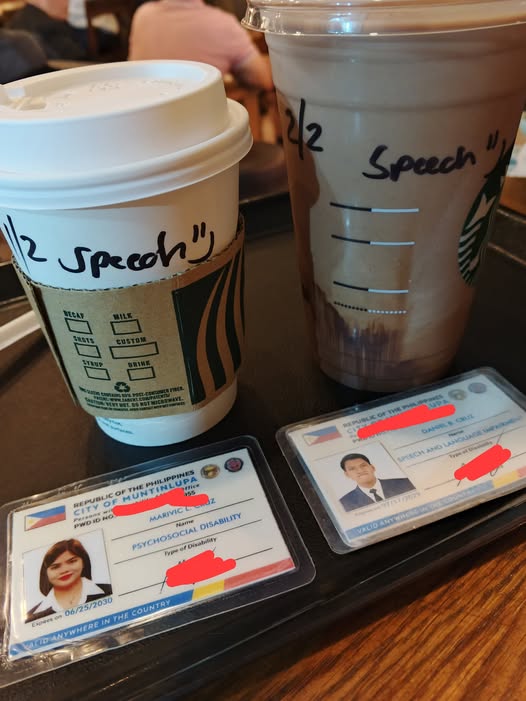
Marivic and Daniel Cruz, a husband and wife who are both persons with disabilities (PWDs), ordered coffee at a local Starbucks branch. To avail of their entitled PWD discount, they presented their government-issued IDs. What they saw on their drink cups shocked them: the word “Speech” was written as their name, seemingly mocking Daniel, who has a speech impairment (Marivic, on the other hand, revealed that she has a psychosocial disability).
To make matters worse, the barista called out “Speech” twice when handing over their orders, adding to the couple’s humiliation.
Marivic posted about the experience on Facebook (link here), and the story quickly went viral, garnering over 39,000 shares and nearly 6,000 comments, most of which condemned the incident.
National Backlash and Legal Implications
The post caught the attention of the National Council on Disability Affairs (NCDA), which released a public statement (link here) calling on Starbucks to take immediate action. NCDA cited a violation of Republic Act No. 9442, which prohibits ridicule and discrimination against persons with disabilities.
Starbucks Philippines eventually issued a formal apology through Bilyonaryo.com, stating that the label “Speech” was written because the employee allegedly mistook the disability noted on the ID as the customer’s name.
But Marivic wasn’t buying it. In a comment under her original post, she pointed out that Daniel did verbally provide his name.
Honest Mistake or Subtle Discrimination?
Was this discrimination or a simple misstep? Personally, I lean toward the latter, but it was a costly one. “Speech” is not a typical name, and assuming it was, especially in this context, reflects poor judgment and a lack of sensitivity.
While the incident may not significantly dent Starbucks’ overall sales in the coffee-loving Philippines, it undeniably left a mark on its brand image. There have been some calls to boycott the chain, but as we’ve seen time and again, outrage rarely leads to lasting consumer behavior change unless reinforced by action or litigation.
If the couple files a formal case and wins, Starbucks could be fined between ₱50,000 to ₱100,000, or its personnel could face up to two years in prison. Realistically, the fine is a drop in the bucket for a global brand, and imprisonment is unlikely.
What Starbucks Did Right and Wrong
In terms of damage control, Starbucks made a few smart moves:
They issued a formal statement via Bilyonaryo, which had already covered the story.
They avoided broadcasting the issue on their own massive social media channels (with over 3.4 million followers), minimizing further amplification.
However, as of this writing, they didn’t appear to extend the same level of response to other media outlets like The Daily Tribune or Manila Standard, which also reported on the issue. A broader PR strategy addressing all major outlets would have been more effective.
Key Takeaway for Marketers
This incident serves as a powerful reminder that branding is not just about logos, slogans, or color schemes. It’s also about experiences. And every touchpoint, even something as seemingly trivial as a name on a cup, can shape public perception.
As the NCDA emphasized, businesses must educate their employees about the rights and dignity of PWDs. A simple mistake—when made during a national week meant to celebrate disability rights—can undo years of positive branding.
For marketers, this is a case study in:
- The risks of personalization gone wrong
- The importance of culturally and socially aware frontline staff
Let’s hope this prompts more brands to prioritize empathy and inclusivity, not just in their campaigns but also in everyday customer interactions.

 OhayoKarlo
Leave a comment